
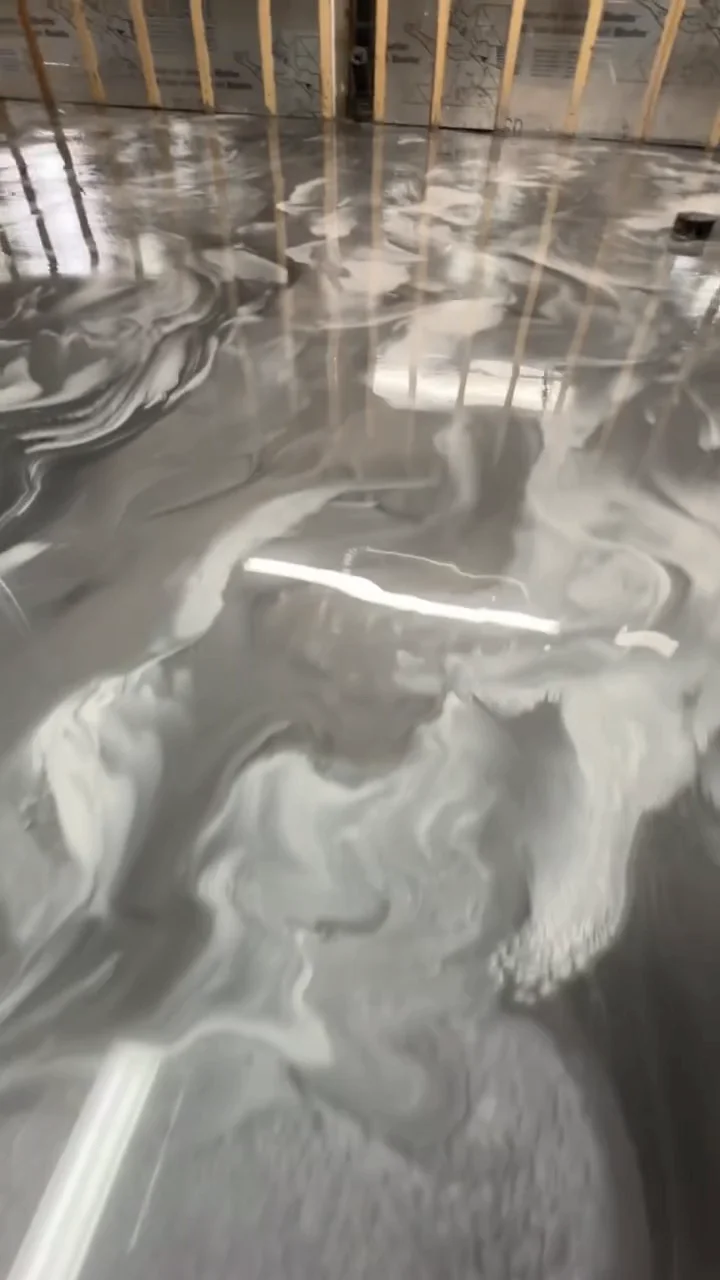
A microcement floor offers a seamless, attractive finish, but its price depends on the condition of the substrate, the surface area, and the finish chosen. At ERA Époxy, in Quebec, we also offer epoxy and polyaspartic systems, including post-disaster restoration finishes, for garages, commercial spaces, and industrial sectors. A quote lets us assess your project with precision.
Microcement, epoxy, and post-disaster floor finishes in Quebec
Microcement is a thin cementitious layer applied over an existing slab to create a continuous surface with no visible joints. Its look appeals to residential and commercial projects seeking a minimalist style. However, in a Quebec context where humidity swings, de-icing salt, and freeze-thaw cycles put heavy strain on garage or warehouse floors, other systems can offer better resistance.
ERA Époxy offers epoxy and polyaspartic systems in metallic, flake, quartz, or solid colour finishes, suited to garages, commercial spaces, warehouses, and basements. When a disaster (water damage, fire, or contamination) has damaged a floor, our post-disaster flooring finish service restores a sound, durable surface using our post-disaster finish product, designed to get the space back in shape quickly while meeting the company's high-end finishing standards.
What makes the price of a microcement or epoxy floor vary
No reliable price can be given without a site visit or precise project details. The following elements directly influence the final cost:
- The condition of the substrate: cracks, settling, or residual moisture require additional preparation before application.
- The total surface area: cost per square foot generally decreases on larger areas, but every project remains unique.
- The type of finish chosen: a metallic or flake effect finish requires more steps than a solid colour.
- The level of concrete preparation: grinding, levelling, or joint repair add to labour time.
- The intended use of the space: a residential garage doesn't have the same requirements as an industrial floor subjected to forklift traffic.
To get an accurate figure, you need to request a quote that includes an on-site evaluation of your floor.
Microcement vs. epoxy and polyaspartic: which finish suits your needs
Microcement works well for low-traffic indoor surfaces where aesthetics come first, such as certain entryways or decorative walls. For a garage, workshop, or high-traffic commercial space, epoxy and polyaspartic systems generally offer better resistance to impact, oil stains, and abrasion, especially when combined with a top coat suited to the intended use.
The choice therefore depends on three factors: expected traffic level, exposure to moisture or chemicals, and the desired aesthetic result. A professional can assess these criteria directly on-site before recommending one system over another.
Real durability: what matters beyond the coating you choose
The durability of a floor, whether microcement or epoxy resin, rarely depends on the material alone. Three factors influence how long a finish lasts:
1. The quality of substrate preparation. Poorly cleaned or poorly ground concrete compromises adhesion, no matter what product is applied on top. 2. The protective system applied. A sealant or top coat suited to the use protects against moisture, stains, and wear. 3. Regular maintenance. Routine cleaning with the right products extends the surface's lifespan and preserves its appearance.
These principles apply just as much to a residential floor as to a commercial or industrial one, and they explain why two similar installations can age very differently depending on how they're maintained.
Common mistakes to avoid before choosing a coating
- Neglecting the condition of the substrate: applying a decorative finish over a cracked or damp slab often leads to premature defects.
- Comparing prices alone without comparing systems. A low price can mean incomplete preparation or a less resistant product.
- Overlooking the actual use of the space. A floor designed for a residential basement doesn't need to meet the same requirements as an industrial warehouse floor.
- Waiting too long after a disaster to act. A delay before repair can worsen damage to the substrate and complicate restoration.
How to get an accurate quote
To find out the real cost of a project, whether it's a residential, commercial, or industrial floor, or a post-disaster flooring finish, an on-site evaluation remains the only reliable method. ERA Époxy serves several regions across Quebec and adapts each system based on the floor's condition, surface area, and intended use. To see the areas we cover, check out our service areas page, and to explore other topics related to floor coatings, visit our blog.
Related reading: