
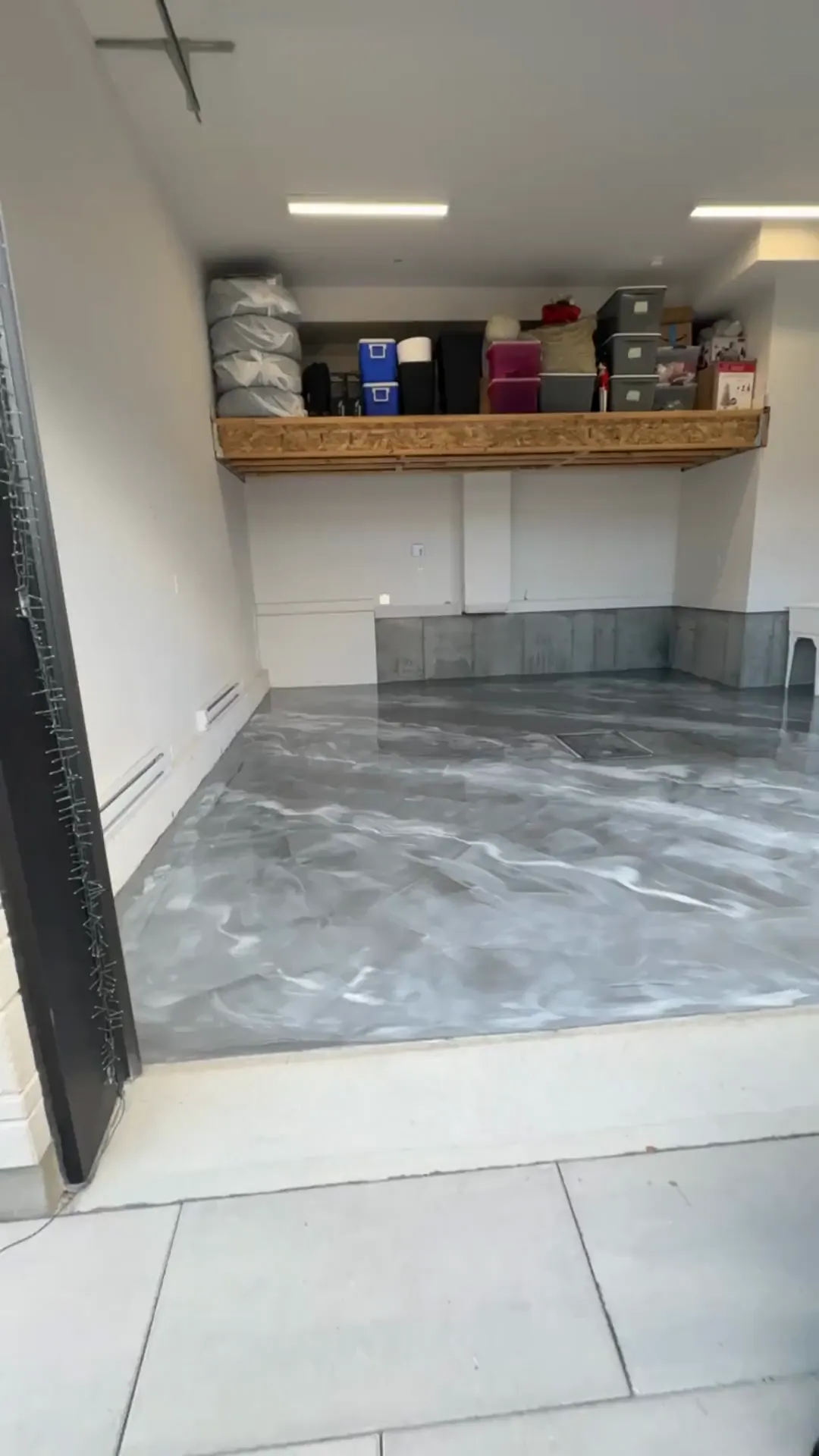
Stained concrete and microcement are thin, decorative coatings that look great but are sensitive to impact and constant moisture. For a garage, shop or industrial floor in Quebec, epoxy and polyaspartic coatings offer resistance that's much better suited to real-world use. ERA Époxy also offers a post-disaster flooring finish designed to get a space back to new quickly.
Stained Concrete or Microcement in Quebec: Understanding the Difference
Microcement and stained concrete are mineral-based coatings applied in a thin layer, often with a trowel, over an existing floor or wall. Their main appeal is visual: a smooth, continuous finish with no visible joints, which works well in minimalist decors.
That said, these products remain surface finishes. How they perform depends entirely on the full system applied: substrate preparation, number of coats, type of sealant and quality of installation. In Quebec, freeze-thaw cycles, basement humidity and the salt tracked in by vehicles in winter are demanding conditions that not every decorative system is built to handle.
What Sets These Finishes Apart From Epoxy and Polyaspartic
Resin-based coatings, like the ones installed by ERA Époxy, are formulated specifically for floors exposed to traffic, impact and chemicals. The company offers metallic, flake, quartz and solid-colour systems, designed for a wide range of uses, from the residential garage to commercial spaces, warehouses and basements.
Unlike microcement, which is primarily aimed at a decorative look for low-traffic walls and floors, an epoxy or polyaspartic system is built up in multiple layers to withstand vehicle weight, repeated abrasion and the occasional spill. The difference isn't just aesthetic, it's a difference in purpose.
Garage, Commercial or Industrial: Which Coating Suits Your Needs
The right choice mostly depends on what will actually be moving across the floor:
- Residential garage: exposure to salt, oil and vehicle weight. A system resistant to chemicals and impact is generally better suited than a purely decorative finish.
- Shop or retail space: moderate foot traffic, with looks as the priority. A decorative finish can work well if the substrate is stable and the sealant is appropriate, but long-term durability should be confirmed before installation.
- Industrial space or warehouse: heavy loads, forklifts, chemical exposure. A system built for these conditions, such as quartz or metallic options, is clearly better suited than a thin decorative coating.
In every case, the condition of the substrate (cracks, residual moisture, flatness) needs to be assessed before choosing one product over another.
After a Disaster: Post-Disaster Finishing as a Lasting Solution
Water damage, fire or flooding often means the damaged flooring has to be removed completely. In this context, choosing the new finish isn't just about appearance: it needs to hold up against any future moisture issues and allow for easy maintenance once the space has been fully restored.
That's why ERA Époxy offers a post-disaster finish designed for exactly this kind of situation. This post-disaster flooring finish is meant to provide a durable, low-maintenance surface once repair work is complete, whether it's a residential basement or a commercial space affected by a disaster.
The Criteria That Should Guide Your Choice
Several factors influence the final result and the type of system recommended:
- Condition of the surface: cracks, moisture, old flooring that needs to be removed.
- Area to be covered: a double garage doesn't have the same constraints as a large warehouse.
- Chosen finish: solid colour, flakes, quartz or metallic effect, each with a different look and intended use.
- Required preparation: sanding, levelling or concrete repair before any application.
These factors vary from one project to another, which is why no generic price can be given without an on-site evaluation. To get a recommendation tailored to your situation, you can request a quote. You can also check the areas we serve to confirm whether your region is covered, or browse the blog for more flooring comparisons.
Related reading: